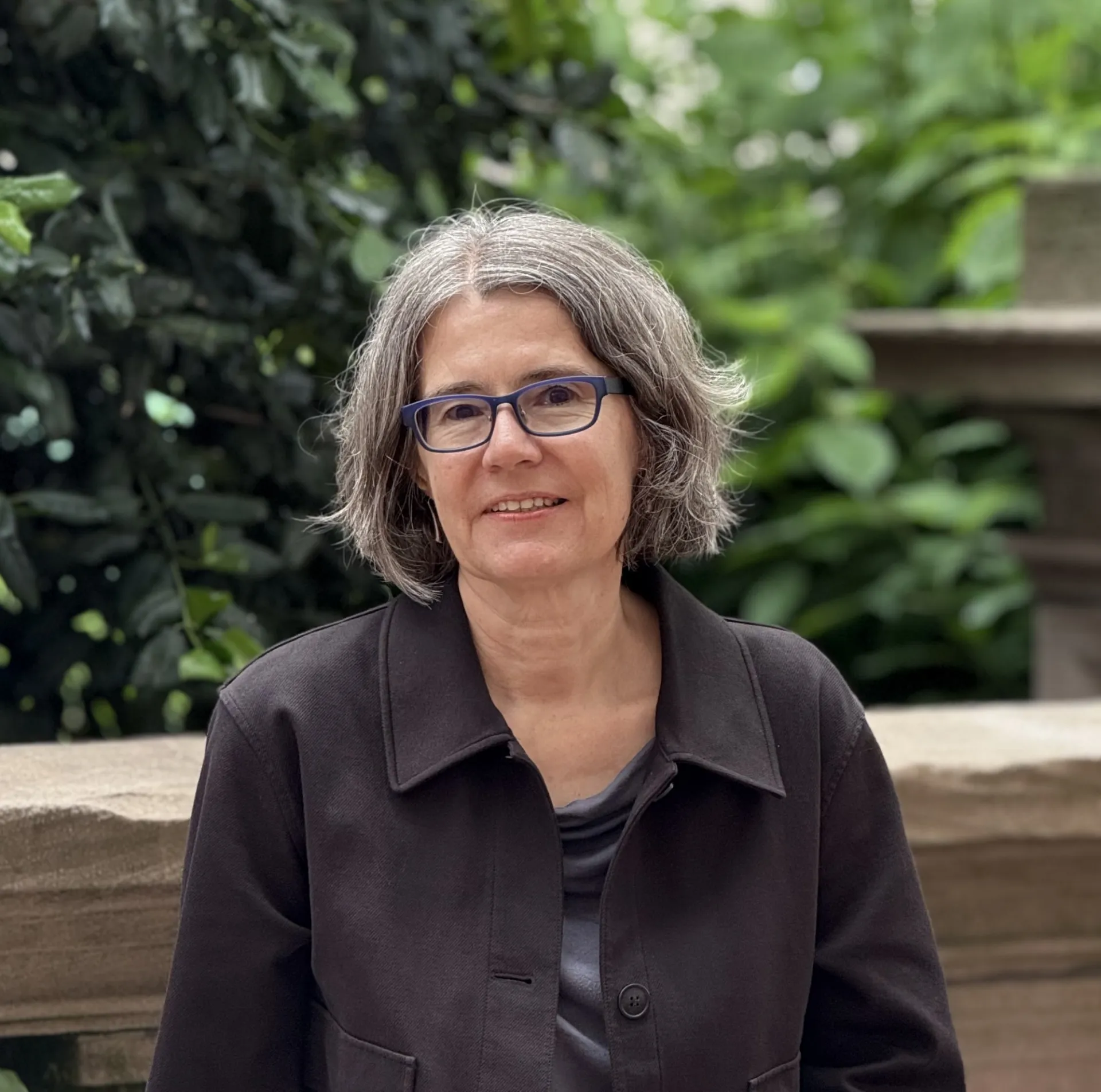
In June 2026, Claudia Breger, Villard Professor of German and Comparative Literature at Columbia University, spent two weeks at Sabancı University’s Faculty of Arts and Social Sciences (FASS) through the Columbia–Sabancı faculty exchange program.
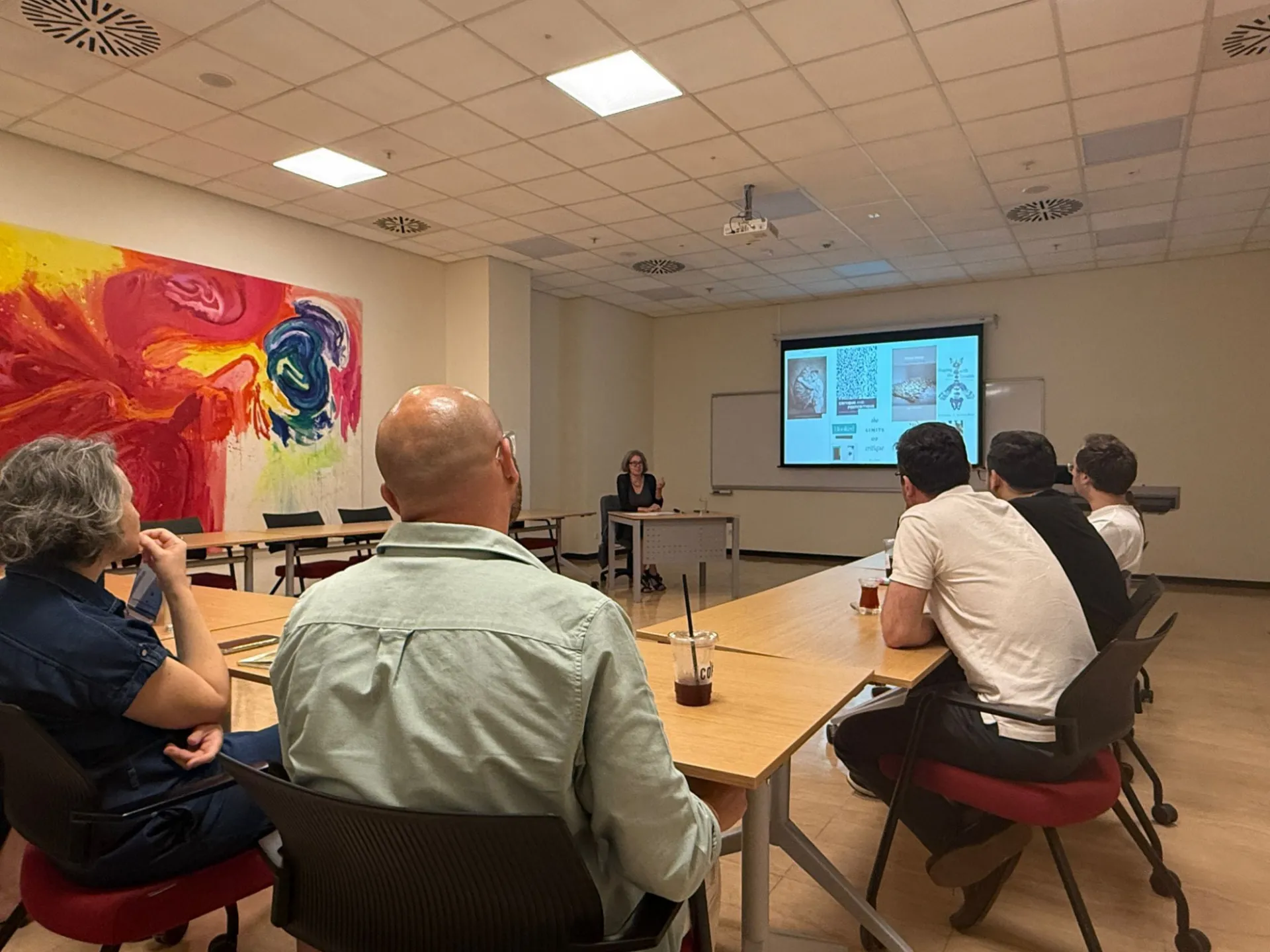
During her visit, Breger presented work from her forthcoming book, Art's Assemblies: Political Aesthetics in Transatlantic Dialogue, at the Global Humanities summer forum hosted by FASS on June 10–12. On June 17, she gave a seminar on her comparative literature research on Turkish and German literary and cultural connections.
This Q&A was conducted following Professor Breger’s visit to Sabancı University.
Could you tell us a bit about yourself and your academic background?
I grew up and received most of my education in (West and post-unification) Berlin, as a literature major with fairly broad interdisciplinary interests, and emerging specializations also in film, theater, and the visual arts. Throughout my career, I have been focused on interrelations between aesthetics and politics, or artistic and social worlds. Given the prominence of Turkish immigrant communities in Berlin, it may not be surprising that Turkish German literature, film, and theater became key to my critical engagements early on. I have approached this body of work from various perspectives over the years: in the 1990s, through (refracted) postcolonial, gender and queer studies lenses, and later in the context of my scholarship on narrative and performance, affect and collectivity. At Columbia, I have also been teaching a global core course (originally designed by my colleague Mark Anderson) on “Berlin/Istanbul.”
What is your current research project about? How does it relate to the field of Turkish studies, broadly construed?
My forthcoming book (https://www.sup.org/books/literary-studies-and-literature/arts-assemblies) rethinks art's power to act politically in and for our contemporary moment, in a dialogue between twenty-first-century perspectives and the twentieth-century German émigré tradition of thinking about aesthetics and politics in response to historical fascism. Demonstrating how Art's Assemblies bring together heterogeneous elements and actions in (polyphonic) “political concert,” the book includes chapters, for example, on how art works through unfinished histories of violence and dehumanization by “animating” archival documents and on how art counters the accumulated political nightmares surrounding us through practices of “dreaming.” In the conceptual vicinity of this larger project, I have been working on several smaller pieces on the aesthetics of assembly, archival animation, and dreaming in Emine Sevgi Özdamar’s work, in particular her 2021 magnum opus Ein von Schatten begrenzter Raum (A Space Delineated by Shadows), which sealed her reputation as one of Germany’s most important literary voices today.
As richly detailed in the novel, Özdamar’s literary aesthetics were co-shaped by her longstanding work in transnational avant-garde theater in Istanbul, France, and East and West Germany, as well as her lifelong engagement with European and world cinema, literature, and art history. For a long time, Özdamar scholarship (including my own) underlined the German inspirations and layers of her work, in part in response to the problematically Orientalizing reception of her earlier novels in Germany. But in the spirit of ever more fully moving beyond such culturalist reception patterns, recent work has begun to delve more deeply also into the modernist Turkish intertextualities of Özdamar’s oeuvre, exploring her acting education and stage work in Istanbul around 1968 and her friendship and exchanges with major Turkish writers, including Ece Ayhan, Turgut Uyar, and Tezer Özlü. The goal of developing a fuller understanding of these Turkish literary and theater ecologies—and Turkish cultural history of the 1960s and 1970s more generally—was a major motivation for my trip to Istanbul and participation in the faculty exchange this year.
A secondary project is teaching-related: in my syllabi for the “Berlin-Istanbul” course, I have been guided, not least, by the goal of giving more equal weight to the “Istanbul” pole, developing transnational perspectives beyond the course’s original focus on Turkish German culture only. This is rooted in my vision for the Global Core as well as humanities teaching more generally: I very much believe in study and thought that reaches across national or other geopolitical boundaries, comparing with an eye on both differences and similarities, while engaging deeply with local archives and histories, linguistic and sociopolitical specificity. In other words, I believe in a curriculum that does not try to cover the whole world in one course—but for example, two complex, tremendously rich cities. Spending time in Istanbul, and getting to know the Sabancı colleagues, was enormously helpful in my ongoing efforts to deepen my own familiarity with entangled Turkish and German histories, the complexity of Turkish society and twentieth- as well as twenty-first-century cultures.
What were some highlights of your visit to Sabancı University? Were there particular encounters or local conversations that stood out to you during your visit to Istanbul?
I find it difficult to pinpoint just a few highlights—it was really the combination of events, activities, and conversations that made my visit so generative. In the first week, I got to participate in the Global Humanities summer forum that Sabancı hosted this year, featuring an interdisciplinary group of speakers from Sabancı along with Beirut, Shanghai, Delhi, Santiago, and Cambridge. The diversity in geopolitical and disciplinary perspectives made for outstanding discussions. I learned so much, both about everyone’s struggles with a difficult political climate for humanities scholarship and teaching and about how to keep up hope. The forum attested not only to impressive resilience and scholarly and pedagogical creativity, but also to some of the good ways in which we are in fact becoming more global: for example, in everyday practices and institutional initiatives of multidirectional exchange beyond traditional center-periphery dynamics.
The forum was held at Sabancı’s Minerva Han in Karaköy, and I got to spend some time based right there in the city. Having been to Istanbul as a regular tourist years ago, I skipped some of the most obvious sights this time (… Hagia Sophia is under renovation anyway!) and focused instead on exploring different neighborhoods and cultural institutions, such as Istanbul Modern and the smaller Cinema Museum. I also really enjoyed the Sabancı museum that we visited as part of the summer forum program, especially the fascinating current exhibition on the evolution of modern Turkish painting. Another highlight was an exhibit at Tütün Deposu in Tophane, curated in collaboration with Berlin partners, on “Love, D-Mark, and Death,” which featured a number of female intellectuals and artists who spent time in Germany as so-called “guest workers”—prominently including Özdamar. (Here I must co-acknowledge the Koç-Sorbonne organizing team of an Özdamar conference that I participated in right before my Sabancı exchange.) I also did a lot of walking and riding the ferry, delving into Taksim and Beyoğlu, Fener and Balat, as well as Üsküdar (one of Özdamar’s locations).
After all the city excitement, I appreciated some quieter time on the Sabancı campus in the second week of my stay (with a couple of additional excursions, in particular to Kadıköy). I am especially grateful for the opportunity to engage in more in-depth conversations with a number of Sabancı colleagues during this time. Once more, the focus was, not least, on the difficulties we face amid political and funding pressures for the humanities (how could it not be!). Getting a better sense of the local configuration on the ground, while sharing some of my own perspectives on—very different but still resonant—pressures at Columbia, was very meaningful to me. But I also simply learned a lot about (and then read up on) the scholarship of Sabancı colleagues intersecting with my projects and broader interests. I am tremendously grateful for the generous hospitality and opportunity to develop my transnational networks.
Did your visit suggest any new ways of thinking about your own work?
Definitely, as indicated already! I was really overdue for spending a little bit of time in Istanbul, in part due to earlier political hesitations about travel—which started to feel rather weird after German colleagues began to express hesitations about visiting the US last year… As I can’t avoid being implicated in life under authoritarian assault, I figured I can at least be as knowledgeable as possible about local conditions, including constraints and spaces for political agency, and think together with colleagues or engage in dialogue about the different places we inhabit in our shared contemporary world. More straightforwardly, I also came home with a ton of new references for books and articles to read, films to watch and art to keep an eye on. Even as my Turkish is, unfortunately, still evolving (I am working on it!), I did make significant progress on the project of getting to know the Turkish ecologies of Özdamar’s oeuvre. And a revamped Berlin-Istanbul syllabus is to come in the fall!